Since the COVID-19 crisis has us all stuck at home, that means we do school from home to!! For my AP Environmental Science class online, we had an assignment to do an inventory of our refrigerators and lights in our house. We were challenged to find the wattage of each light and of each fridge. Along with finding the hours of operation, location, kWh per day, and cost per kWh.
Here is my inventory:
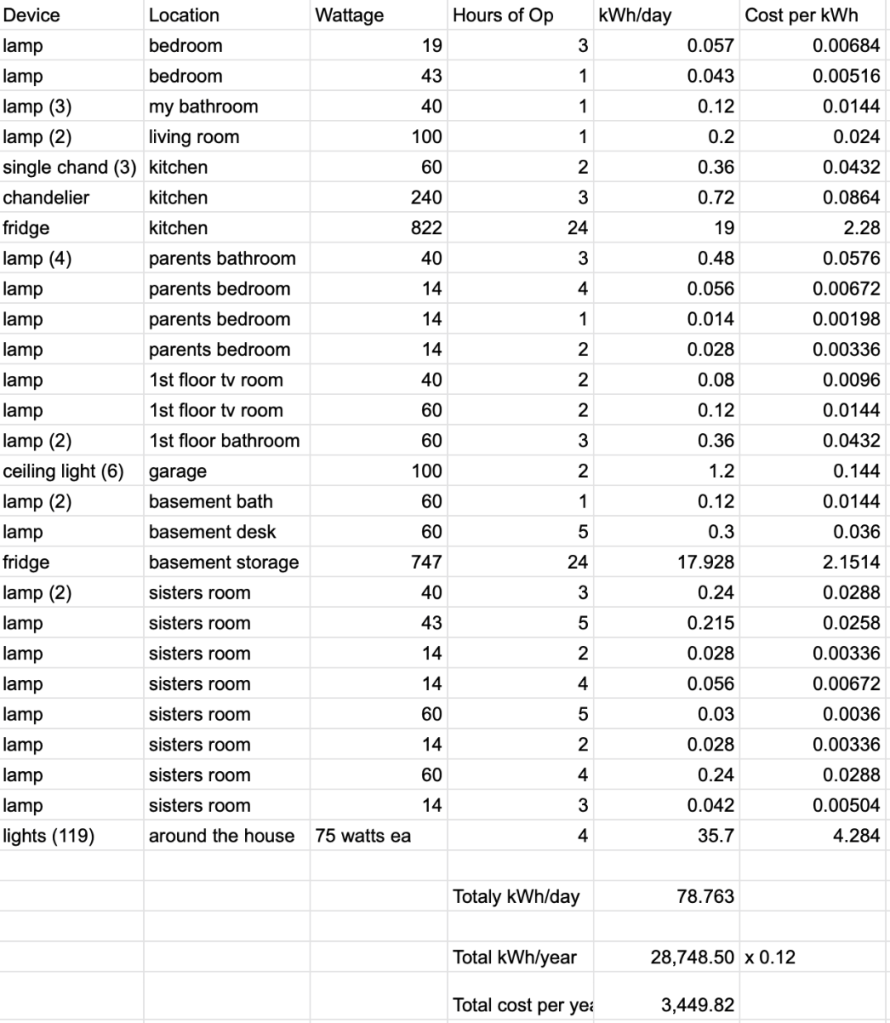
After we finished our inventory, we calculated the total kWh per day, total kWh per year, and then the total cost per year. For the total kWh per day, you would add up all of kWh that your devices use. For the total kWh per year, you would multiply the kWh per day by 365. To get the total cost per year, you would multiply whatever the cost is for your state, in Massachusetts it is $0.12, by the total kWh per year.
The next part of the assignment was to calculate our GHG emissions. To do that, you first have to find your states electrical source percentages. In Massachusetts, the electrical source percentages are: 66% natural gas, 15% nuclear, and 7% solar. Once we found those, we had to calculate the mmBTU’s for each source. That equation is:
annual kWh/year x percentage of source x 3412/1,000,000 = ____ / mmBTU
We then calculated the CO2 output for each source. Luckily for me, only natural gas produces CO2, solar and nuclear do not. We were given the kg of CO2 produced per mmBTU for each energy source, and our job was to use our data to figure out how much CO2 we are producing. The next step was to find how much you would have to pay if there was carbon fee of $15 per metric ton. We had to convert our kg of CO2 into metric tons of CO2 (1000kg = 1 metric ton), and once you got how many metric tons you produce, you multiply that number by 15, to get the annual cost of your carbon emissions.
Here is my table:

Can I drawdown my emissions to zero?
I do think that I could make adjustments to my household and to the way I live to not produce any emissions. Although it would be very hard, I think it could be possible. Especially because two fo the three biggest energy sources in Massachusetts don’t produce any emissions at all. To do that, I could get LED lights, be more cautious of when things are plugged in and when lights are on, etc. However, even though I think I could achieve that goal because of the low amount of CO2 emissions I produce, I do not thin it is entirely realistic because of the number of devices in my house and because of the way we live these days, technology and electricity is everywhere and the more there is, the more CO2 emissions there will be.
 APES Blog - Lila